
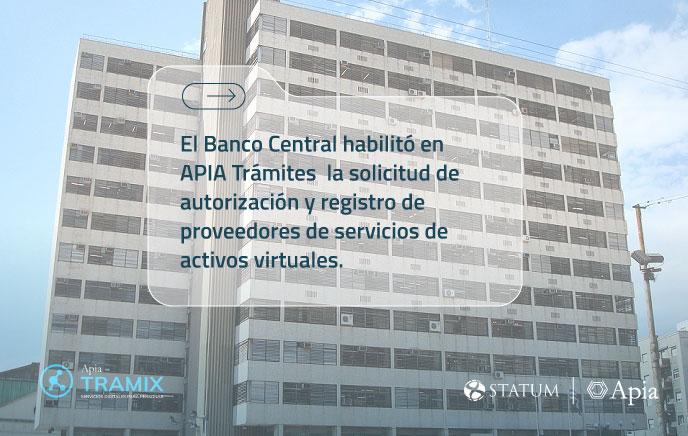
Central Bank of Uruguay Enables Applications for Authorization and Registration of Virtual Asset Service Providers on ApiaTrámites
SUMMARY:
The Financial Services Superintendency (SSF) of the Central Bank of Uruguay (BCU) has enabled a 100% online communication channel for legal entities engaged in activities related to virtual assets to apply for the authorization required to operate. The procedure, developed on ApiaTrámites, is called Application for Authorization and Registration of Virtual Asset Service Providers and is available on gub.uy.
INFORMATION:
Activities covered by the authorization
The application is intended for legal entities that carry out activities involving the exchange, transfer, custody or administration of crypto-assets and digital tokens on a daily basis. These activities are also covered when they are carried out through protocols that allow them to be performed directly between users through smart contracts, i.e., programs that automatically fulfill the conditions agreed upon by the parties.
Regulatory framework underlying the procedure
The launch of the channel is part of the new regime approved by the Financial Services Superintendency for virtual asset service providers and, at the same time, complies with current legislation. The regulations establish the conditions for their operation and supervision in Uruguay, and define the activities and requirements that must be met by those operating in this market.
In a context of increasing use of virtual assets, the Central Bank of Uruguay is promoting a regulatory framework aligned with international best practices, with the aim of fostering reliability and predictability for the development of new technologies and business models.
Requirements, costs and access
The requirements are intended to strengthen user protection, risk management, information security and the prevention of money laundering.
To initiate the application, applicants must have a gub.uy user account with an intermediate verified security level or another electronic identification method, such as a Digital Identity Card, Abitab Digital Identity or Antel TuID. An advanced electronic signature and a professional stamp issued by the Caja de Jubilaciones y Pensiones de Profesionales Universitarios (CJPPU) are also required. Costs depend on the number of affidavits submitted and their corresponding professional stamps.
In accordance with Decree 353/23, public entities may not impose additional requirements or request certificates, records, statements or other documentation when the relevant information can be obtained through secure digital means from other entities. The procedure also includes a specific form for submitting complaints in cases of non-compliance with the provisions of the Decree.



Comments (0)
Leave a comment